



Jumping rope is a familiar, easy-to-perform cardio workout chosen by many people looking to lose weight and reduce fat at home. However, does jumping rope actually help you lose weight, how much energy can each session burn, and how should you train to maximize results while minimizing injury? The article below explains how jumping rope supports weight loss, proper jumping technique, a beginner-friendly schedule, and the nutritional principles to combine for optimal fat loss.
Does Jumping Rope Help You Lose Weight?
Jumping rope is a form of cardio that elevates heart rate, boosts energy expenditure, and supports weight management when maintained regularly at an intensity suited to your fitness level. However, the calories burned while jumping rope are not fixed; they depend on factors such as body weight, workout duration, technique, and especially jumping speed. Energy expenditure during exercise is commonly estimated using the MET index, where 1 MET equals the energy expended at rest. The higher the MET value, the more energy the body requires to perform the activity.
MET by jump rope intensity:
| Activity type | MET |
| Slow jump rope under 100 skips/minute | 8,8 MET |
| Moderate-speed jump rope 100-120 skips/minute | 11,8 MET |
| Fast jump rope 120-160 skips/minute | 12,3 MET |
As shown in the table above, slow jump rope under 100 skips/minute equals about 8.8 METs, moderate-speed jump rope at 100-120 skips/minute equals about 11.8 METs, and fast jump rope at 120-160 skips/minute equals about 12.3 METs.
MET is an index used to estimate the energy expenditure of an activity compared with a resting state.
The commonly used formula to estimate energy expenditure is: kcal/minute = (MET × 3.5 × body weight in kg) / 200
For example, for a person weighing 50 kg jumping rope for 30-60 minutes, estimated energy expenditure varies by speed:
- Slow jump rope: burns approximately 231-462 kcal
- Moderate-speed jump rope: approximately 310-620 kcal
- Fast jump rope: approximately 323-646 kcal.
In terms of scientific evidence, a randomized controlled trial in adolescents with overweight or obesity found that a 12-week interval jump rope program, performed 3 sessions per week, improved body weight, BMI, body fat percentage, and cardiovascular endurance. In that study, participants were instructed to maintain their usual your diet without strict portion control throughout the intervention, so the findings should be interpreted in the context of jump rope combined with routine daily habits.
In addition, a meta-analysis of 21 studies involving 1,021 participants also reported that jump rope training can improve multiple health- and fitness-related metrics, including BMI, fat mass, and cardiovascular endurance. However, the degree of dietary control varied across studies; therefore, jumping rope should be viewed as part of a comprehensive exercise and lifestyle management program rather than a standalone determinant of results. weight management.
Still, jumping rope remains a form of cardio. For more effective and sustainable weight loss, you should not rely on jumping rope alone but also incorporate resistance training. Resistance exercise helps preserve muscle mass, improve strength, and support metabolism, making the weight loss process healthier and more effective.

For more effective and sustainable weight loss, you should not rely on jumping rope alone but also incorporate resistance training

How to Jump Rope Properly for Effective Weight Loss
Jumping rope helps burn calories quickly and supports effective weight loss when performed with proper technique. To achieve good results while minimizing injury risk, follow these five basic steps:
- Step 1: Prepare appropriate equipment
First, choose a jump rope suited to your height. When standing on the center of the rope and pulling both handles upward, the handles should reach chest level or slightly lower. Beginners should choose a lightweight PVC or rubber rope for easier control. Once comfortable, you can switch to a weighted rope to increase training intensity. Also wear athletic shoes with good shock absorption and train on a flat surface with slight cushioning. - Step 2: Warm up before exercising
Warming up for 10-15 minutes helps raise body temperature and improve mobility in joints such as the ankles, knees, and shoulders. This is an essential step to reduce injury risk during exercise. - Step 3: Use proper jumping technique
While jumping, keep your back straight and look forward. Lower your elbows slightly and bend them at about 90 degrees, using your wrists to turn the rope rather than swinging your whole arms. Keep your feet close together, land on the balls of your feet, and keep your knees slightly bent to absorb impact on the joints. - Step 4: Adjust workout intensity
Beginners should start with short intervals, alternate with rest, and gradually increase duration as the body adapts. Increasing intensity step by step helps the body adapt better and enhances burning kcal. - Step 5: Cool down and stretch after exercising
After finishing your workout, walk lightly or perform stretching exercises to bring your heart rate and breathing back to normal. Also rehydrate adequately and get proper rest.
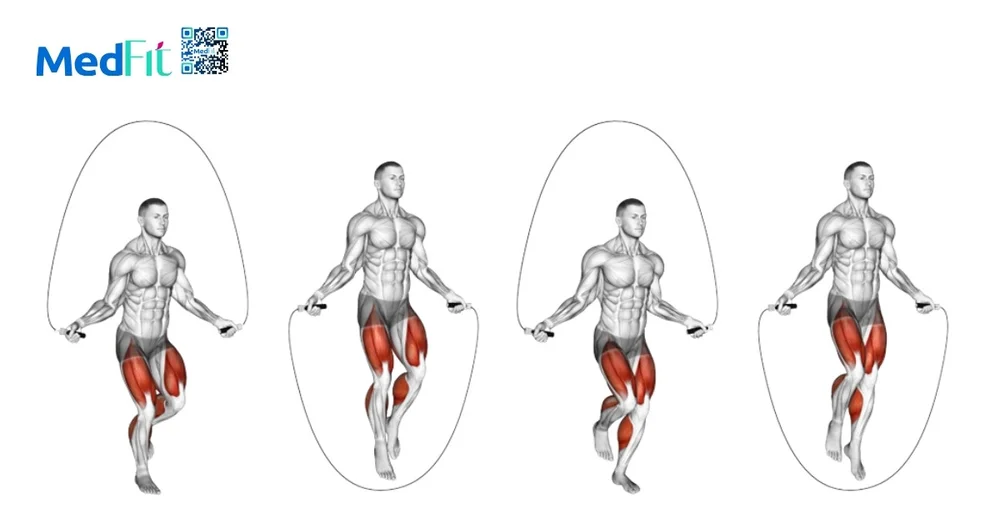
Jumping rope helps burn calories quickly and supports effective weight loss when performed with proper technique

4-Week Jump Rope Weight Loss Schedule for Beginners
For beginners, a jump rope weight loss schedule should be structured with gradual progression so the body has time to adapt. Before each session, warm up for 5-10 minutes with wrist rotations, ankle rotations, knee raises, brisk marching in place, and light hops to warm up the body.
- In Week 1: start with 10 minutes/session. The workout consists of 30 seconds of basic jumps and 30 seconds of rest, repeated for 10 rounds. Aim for 3 sessions/week with at least one rest day between workouts for recovery.
- In Week 2: increase workout duration to about 12 minutes/session. The workout consists of 45 seconds of basic jumps, 30 seconds of alternate-foot step jumps, and 45 seconds of rest, repeated for 6 rounds. If your stamina feels stronger, you may increase to 4 sessions/week.
- By Week 3: workout duration can increase to about 15 minutes/session. The workout consists of 60 seconds of basic jumps, 30 seconds of high-knee jumps, and 30 seconds of rest, repeated for 7 rounds. Maintain about 4 sessions/week to boost fat burning.
- In Week 4: continue with about 15 minutes/session at a higher intensity. The workout consists of 60 seconds of basic jumps, 45 seconds of alternate-foot step jumps, 30 seconds of high-knee jumps, and 45 seconds of rest, repeated for 5 rounds.
During the workout, keep your back straight, look forward, keep your elbows close to your sides, and turn the rope mainly with your wrists. Jump low and land softly on the balls of your feet to reduce joint stress.
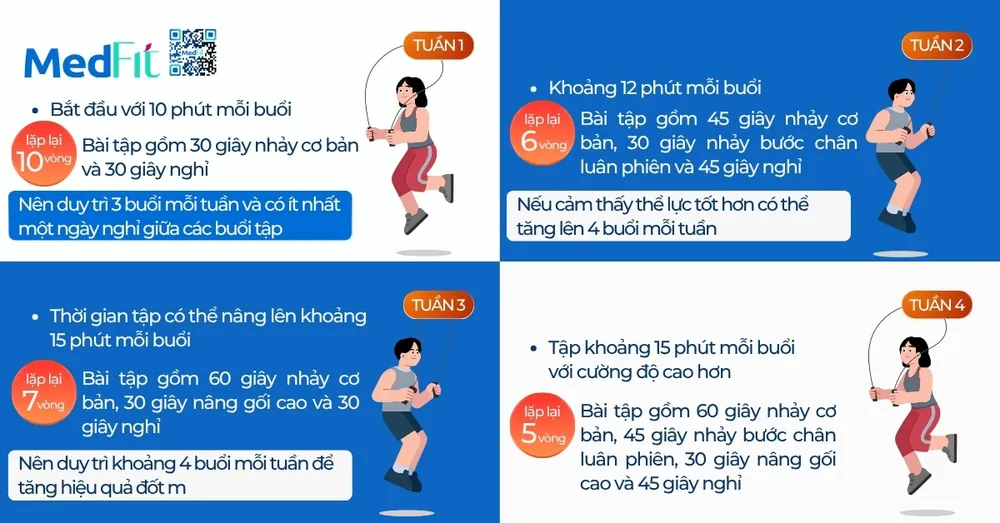
For beginners, a jump rope weight loss schedule should be structured with gradual progression so the body has time to adapt

Nutrition Tips to Combine for Optimal Weight Loss Results
Jumping rope has long been considered a simple yet effective cardio exercise that elevates heart rate, burns energy, and supports fat reduction when maintained regularly. However, for a weight loss journey to be not only fast but also sustainable, you should not stop at jumping rope alone. Adding resistance training helps preserve and build muscle mass, thereby improving energy metabolism and toning the body.
Alongside exercise, nutrition plays a decisive role in success. A scientific diet should maintain an appropriate energy deficit while providing adequate protein to nourish muscles, combined with leafy greens, fruits, and quality carbohydrate sources. Limiting foods high in sugar and unhealthy fats also helps manage weight more effectively.
When jumping rope, resistance training, and proper nutrition are harmoniously combined, you not only reach your weight loss goals but also build a healthy, toned body that is easy to maintain long term.

Train with a coach at MedFit for effective workouts tailored to your fitness level
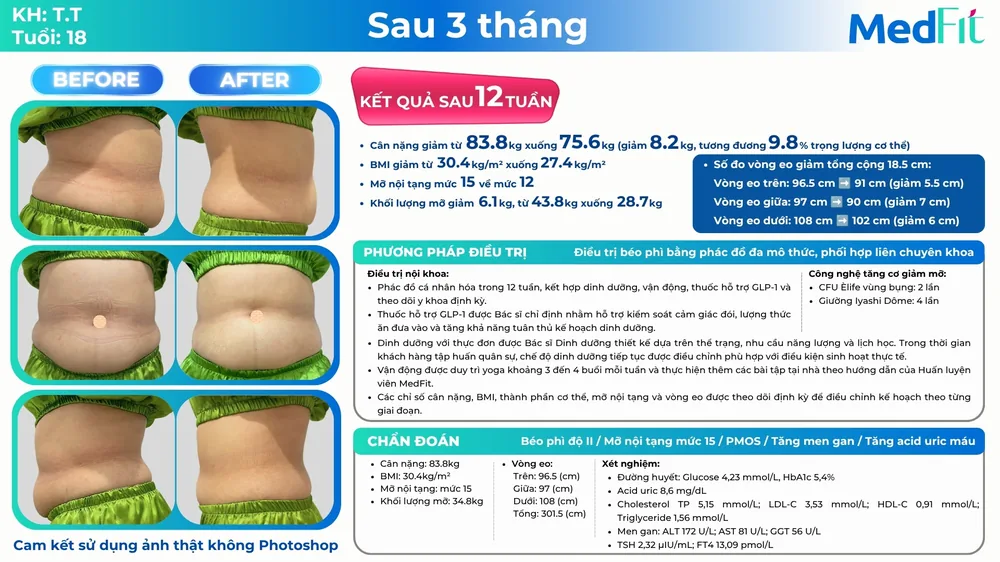
Weight-Loss Clinical Cases at MedFit Clinic
Jumping rope is a simple cardio workout that helps raise heart rate, burn energy, and support weight management. However, results still depend on workout intensity, technique, physical condition, and diet. To achieve weight management safely, train regularly, increase intensity gradually, warm up thoroughly, and stretch afterward. It should not be the only method; combining it with resistance training, a balanced diet, adequate sleep, and a healthy lifestyle will help reduce fat effectively and maintain a toned physique long term.
If you are looking for a weight management plan that is scientific and suited to your physical condition, MedFit can accompany you with a personalized approach. At MedFit, Physicians, Nutrition Specialists, and coaches collaborate to evaluate your health, develop a meal plan, design an exercise program, and consider medical interventions when needed. As a result, the process of weight management becomes safer, more practical, and more sustainable. Book a consultation with MedFit today to build a strategy aligned with your current goals.
References
- Compendium of Physical Activities. (2024). Compendium of Physical Activities. [online] Available at: https://pacompendium.com/ [Accessed 13 October 2026]
- Leisure and Cultural Services Department. (n.d.). Rope Skipping for Fun. [online] Available at: https://www.lcsd.gov.hk/en/healthy/rope.html [Accessed 13 October 2026]
- Shao S, Cao M. Integrating interval jump rope exercise into a school setting improve body composition, cardiorespiratory fitness and glycolipid metabolism parameters in adolescents with overweight and obesity: a randomized controlled trial. BMC Pediatr. 2025;25:945. doi:10.1186/s12887-025-06320-1
- Phongchin W, Tingsabhat S, Trongjitpituk R, Reun-Arom T, Poon ET, Wongpipit W. Effects of high-intensity interval rope-skipping on cardiorespiratory fitness, body composition, and enjoyment in young adults. Eur J Clin Nutr. 2025. doi:10.1038/s41430-025-01575-4
- Leisure and Cultural Services Department. (n.d.). Rope Skipping for Fun. [online] Available at: https://www.lcsd.gov.hk/en/healthy/rope.html [Accessed 13 October 2026]
- Seek Weight Loss. (n.d.). Jump Rope. [online] Available at: https://www.seekweightloss.com/jump-rope/ [Accessed 13 October 2026]